
Why DIY Cleaning After Renovation Is a Bad Idea (And What Professionals Do Differently)
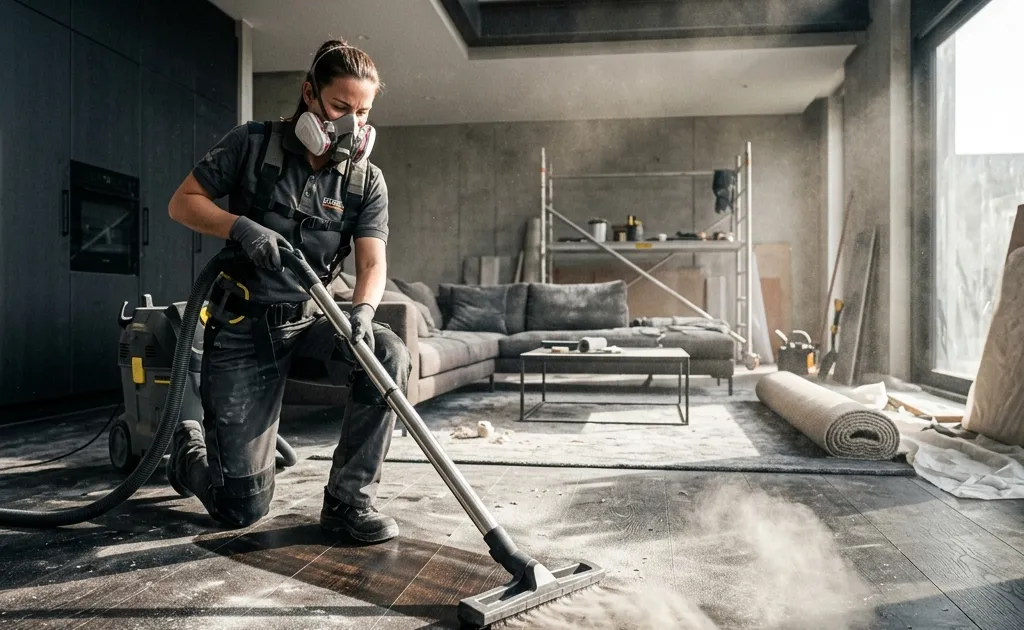
The contractors have packed up, the new cabinets look perfect, and the freshly painted walls are finally dry. The renovation is done — but the cleanup is not even close. What looks like a light coating of dust on every surface is actually a complex mixture of fine particles that can stay suspended in your indoor air for days, settle into HVAC ductwork, and bond to surfaces in ways that a weekend with a mop and a household vacuum will not resolve. Here is what is actually in that dust, why amateur cleaning makes the situation worse, and what professional post-construction cleaning in the Charlotte metro does differently.
The Real Health Risks of Construction Dust
Construction and renovation dust is not a single substance — it is a mixture of several distinct hazardous materials, each with its own health implications.
Crystalline silica is present in drywall, concrete, mortar, brick, and most tile. When cut, drilled, or sanded, these materials release respirable silica particles small enough to reach deep lung tissue. OSHA classifies crystalline silica as a Group 1 carcinogen — the same category as asbestos — and links repeated exposure to silicosis, lung cancer, and COPD. A single renovation is unlikely to cause occupational-level exposure, but children and elderly residents spending hours in a space with residual silica dust face meaningful risk.
Drywall dust and legacy materials add another layer of concern. Homes built before 1980 may contain asbestos in popcorn ceilings, floor tile adhesive, pipe insulation, or joint compound. Disturbing these materials during renovation releases fibers that are invisible to the naked eye and have no safe exposure threshold. If your renovation touched any pre-1980 materials and you did not have an asbestos assessment done beforehand, professional post-renovation cleaning — not DIY — is the appropriate response.
Volatile organic compounds (VOCs) from fresh paint, adhesives, caulks, sealers, and new flooring off-gas into indoor air for days to weeks after application. According to the U.S. Environmental Protection Agency, indoor air can be 2 to 5 times more polluted than outdoor air — and immediately after a renovation, that ratio can be far higher. VOCs cause headaches, eye and throat irritation, and with prolonged exposure, more serious neurological effects.
Why Your Household Vacuum Makes It Worse
The instinct to reach for a vacuum immediately after renovation is understandable — but the wrong vacuum actively worsens the air quality problem. Standard household vacuums, including many “bagless” models marketed as high-performance, use filtration systems that capture large particles while exhausting fine particles back into the room through the motor exhaust. Silica particles smaller than 10 microns — the size most hazardous to the lungs — pass straight through non-HEPA filters.
The result is that running a standard vacuum over post-construction surfaces aerosolizes the fine particles that had settled, putting them back into suspension in breathing air where they can stay aloft for hours. HEPA filters, by contrast, are rated to capture 99.97% of particles at 0.3 microns — small enough to intercept the silica and drywall dust that causes the most damage. Industrial wet/dry vacuums used by professional cleaning crews combine HEPA filtration with suction power that is three to five times greater than residential units, capturing material that household vacuums cannot reach.
Direction of cleaning also matters in a way most homeowners underestimate. Construction dust is continuously settling from ceiling height down to the floor over a period of days. Cleaning floors first, then surfaces, then dusting above — the natural impulse — simply redirtens surfaces you already cleaned. Professional post-construction cleaning always works top to bottom, and returns for multiple passes over 24 to 48 hours as residual suspended dust settles.
What Professional Post-Construction Cleaners Do Differently
The difference between a professional post-construction clean and a thorough DIY effort is not primarily effort — it is equipment, protocol, and material knowledge that takes years to develop.
Industrial equipment gives professionals access to tools that simply are not available at hardware stores: commercial-grade HEPA wet/dry vacuums with sealed filtration systems, microfiber flat mops rated for construction residue, industrial steam cleaners for grout haze on new tile, and single-edge razor scrapers paired with professional glass cleaners for paint-spattered windows. Each tool is matched to a specific type of post-construction residue.
The multi-stage protocol is what separates a professional clean from a thorough amateur one. Stage one (rough clean) removes all large debris and does a first-pass vacuum of every surface. Stage two (detail clean), performed 24 hours later after initial dust has re-settled, addresses every surface methodically from ceiling to floor. Stage three (final clean) is a white-glove inspection pass — raking light across windows, HEPA-vacuuming HVAC vents and registers, and wiping every switch plate and outlet cover. Most DIY efforts skip stages two and three entirely.
Material-specific knowledge prevents damage that is expensive to repair. New hardwood floors cannot be wet-mopped — standing water causes edge warping. Grout haze on new tile requires an acidic haze remover, not an all-purpose cleaner. Fresh paint on walls needs a dry microfiber wipe, not a damp cloth that lifts the surface sheen. Paint overspray on glass must be scraped before any liquid cleaner is applied, or fine abrasive damage is permanent. Professionals know which product and method is correct for each surface type before starting.
When Professional Post-Construction Cleaning Is Non-Negotiable
DIY cleaning after renovation is reasonable for minor cosmetic updates in otherwise clean spaces. It becomes inadequate — and potentially hazardous — in four specific situations:
- Any project involving new drywall installation or sanding. Drywall finishing creates the finest, most persistent dust of any common renovation task. It penetrates every opening, coats every surface, and requires professional HEPA equipment to fully remove.
- Renovations in homes built before 1980. The potential for disturbed asbestos or lead paint dust means professional cleaning — and potentially professional remediation — is the appropriate response, not a DIY clean.
- Households with children, elderly residents, or anyone with asthma, COPD, or other respiratory conditions. These groups have significantly lower tolerance for residual particulate exposure and should not return to a renovated space until a professional clean has been completed and HVAC filters have been replaced.
- Commercial properties with a committed opening date. A single professional crew can complete a post-construction clean in the time it would take an owner’s staff to make one pass through a large space — and with significantly better results for a client walkthrough or health inspection.
Charlotte’s Climate Makes Post-Construction Dust Worse
The Charlotte metro’s humidity creates a post-construction cleaning challenge that homeowners in drier climates do not face. Across the Piedmont — Charlotte, Huntersville, Concord, Mooresville — summer relative humidity regularly exceeds 70%, and the region’s notorious red clay soil is present on every active construction site. That clay dust, when tracked inside during construction and combined with indoor humidity, bonds to painted walls, new flooring, and window glass in a way that dry-dusting will not release. Acidic cleaners are required for red clay on light-colored surfaces, and the bonded film on windows requires wet scraping before any glass cleaner is effective.
Nate’s Cleaning provides professional post-construction and renovation cleaning for homeowners and contractors across 5 Charlotte metro counties — Mecklenburg, Cabarrus, Union, Gaston, and Iredell. Whether your project is a kitchen remodel in Charlotte, a new build in Huntersville, or a commercial renovation in Concord, our HEPA-equipped crews handle every stage of the post-construction clean from rough debris through final inspection. Request a free estimate for your renovation project.